The Future of Research Careers in a Technology-Driven Academic World
The Future of Research Careers in a Technology-Driven Academic World
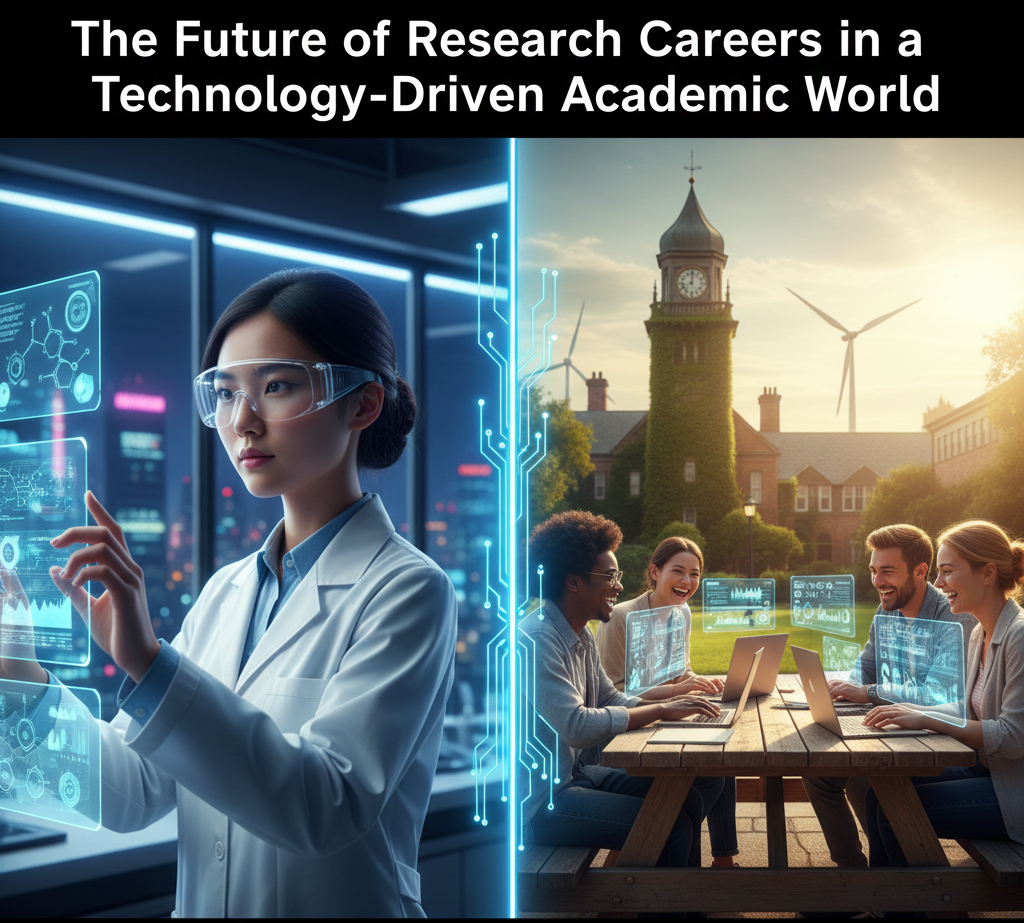
As technology continues to disrupt the academic scene, research jobs are experiencing a significant transition. Researchers will have to adapt to a setting characterized by automation, sophisticated data systems, cutting-edge collaboration technologies, and the quick dissemination of knowledge in the years 2025 and beyond. The method in which research is carried out is being transformed by technology, but it is also altering what it means to be a successful researcher in a world that is interconnected on a global scale and driven by innovation.
Utilizing State-of-the-Art Technologies to Broaden the Range of Inquiry
With the use of technological developments such as artificial intelligence, machine learning, big data analytics, and computational modeling, researchers are now able to investigate problems that were previously considered unanswerable. By providing more in-depth insights, more rapid analysis, and more precise forecasts, these technologies are able to extend the bounds of scientific investigation. Because of this, researchers are able to concentrate their efforts on the more advanced aspects of interpretation, creativity, and invention.
Enhancing the Effectiveness of Data Gathering and Examination
Research processes are being made more efficient with the assistance of automated data gathering technologies, digital sensors, and sophisticated analytics systems. It is now possible to do tasks in a fraction of the time that they formerly required. For example, data processing, literature review, and pattern detection were historically tasks that may take months to complete. Researchers are able to devote more time to perfecting hypotheses and investigating new concepts and less time to operations that are repetitive as a result of this efficiency.
Increasing Cooperation on a Worldwide Scale
By removing geographical limitations, technology has made it possible for researchers from many places to work together in real-time. It is possible to achieve seamless cooperation via the use of virtual conferences, shared data platforms, cloud-based research settings, and digital communication tools. Researchers are able to participate in projects that span the globe, access a wide range of resources, and contribute to studies that are conducted on a larger scale with more ease thanks to these worldwide networks.
Altering Academic Positions and the Qualifications Necessitated
In order to be successful, a contemporary researcher must have a combination of both conventional academic talents and technology competences. Coding, data visualization, software literacy, and algorithmic knowledge are all examples of skills that are becoming more important. It is required of researchers that they not only be experts in their respective fields but also have a clear understanding of the ways in which digital technologies may improve the quality of their work. As a result of this change, academic institutions are now more likely to include training in technology within their various programs of study.
Increasing Need for Multidisciplinary Knowledge
It is becoming more common for cooperation to take place across different disciplines as research issues get more complicated. Expertise from a wide variety of disciplines, including but not limited to engineering, biology, data science, social sciences, and environmental studies, is often required for research that is technology-driven. This motivates academics to take on more expansive viewpoints, collaborate with individuals from other disciplines, and create solutions that comprehensively address problems that have an impact on the whole world.
Increasing Transparency and Reproducibility
By facilitating the availability of data with open access, automatic documentation, and the ability to keep track of workflows in a transparent manner, digital technologies may help increase the level of openness that is present in research. These enhancements make it possible to improve the reproducibility of research, which is a major problem in a wide range of academic disciplines. Researchers have the ability to use digital platforms to share their methodology, datasets, and code, which in turn encourages a greater sense of trust and cooperation among the scientific community.
Increasing the Number of Available Funding Sources by Utilizing Technology
New opportunities for collaborations with the industry and grants have been made possible by technology, which is impacting the way that financing patterns are arranged. Research that incorporates elements such as artificial intelligence, sustainability, automation, or digital transformation often draws substantial funding. In addition, applications that are based on facts and provide evidence of quantifiable benefit have a greater chance of being approved by funding organizations.
Growing Utilization of Simulated Laboratories and Virtual Environments
Researchers are able to carry out experiments that could be too expensive, hazardous, or complicated to execute in conventional environments by using virtual labs. Prior to the implementation of actual experiments, simulations may be used for the purpose of model testing, result prediction, and hypothesis refinement. This method expedites the pace of research while simultaneously minimizing the amount of wasted resources and the difficulties associated with logistics.
Bringing Up Ethical Issues in the Course of Research
Ethical issues are becoming more significant as technology becomes more widespread. Researchers need to take into consideration problems that are associated with the privacy of data, the presence of bias in algorithms, the openness of artificial intelligence, and the responsible use of new technology. In order to make sure that advancements in technology are in line with the ideals of society, ethical training is becoming a fundamental part of the growth of academics.
Assisting Research Work That Is Done Remotely
The ability to operate remotely has led to a redefinition of the way research is carried out. A wide variety of research-related activities, such as writing, data analysis, virtual experimentation, and cooperation, may now be carried out from any location. Because to this flexibility, those who may not have access to conventional on-campus surroundings can now pursue academic professions, and everyone can achieve a better balance between their job and personal life.
Changing the Way That Publication and Dissemination Are Carried Out
The distribution of research is being made more accessible and quicker due to the use of digital platforms, preprint archives, and artificial intelligence-assisted review processes. Researchers are able to quickly disseminate their results, obtain instantaneous comments from their colleagues, and improve their work prior to its official publication. Because of this faster cycle, the visibility and effect of scholarly contributions are both improved.
Getting Ready for the Professional Roads Ahead
The range of options that are available for those who are pursuing research careers is expected to become more varied in the future, including chances both inside and outside of the academic setting. The acquisition of technology-driven skills enables researchers to make the move to positions in a variety of sectors, including those of business, government, consultancy, and innovation. There is an increasing need for experts who can blend analytical thinking with technology ability, and these expanding paths are a reflection of that.
The future of jobs in research is characterized by quick advancements in technology, cooperation across several disciplines, methodologies that make extensive use of data, and a worldwide network of connections. The job of researchers will become more significant in the future as technology is incorporated into every aspect of academic life at universities and research institutions. Researchers will be crucial in the advancement of innovation, the formulation of policy, and the resolution of some of the most intricate issues facing the globe. In this setting, which is continuously undergoing transformation, the people who will pave the way for the academic world of the future will be those who embrace technology, who adapt to new tools, and who develop abilities that span several disciplines.