Hybrid Degree Models: Blending Online and On-Campus Education
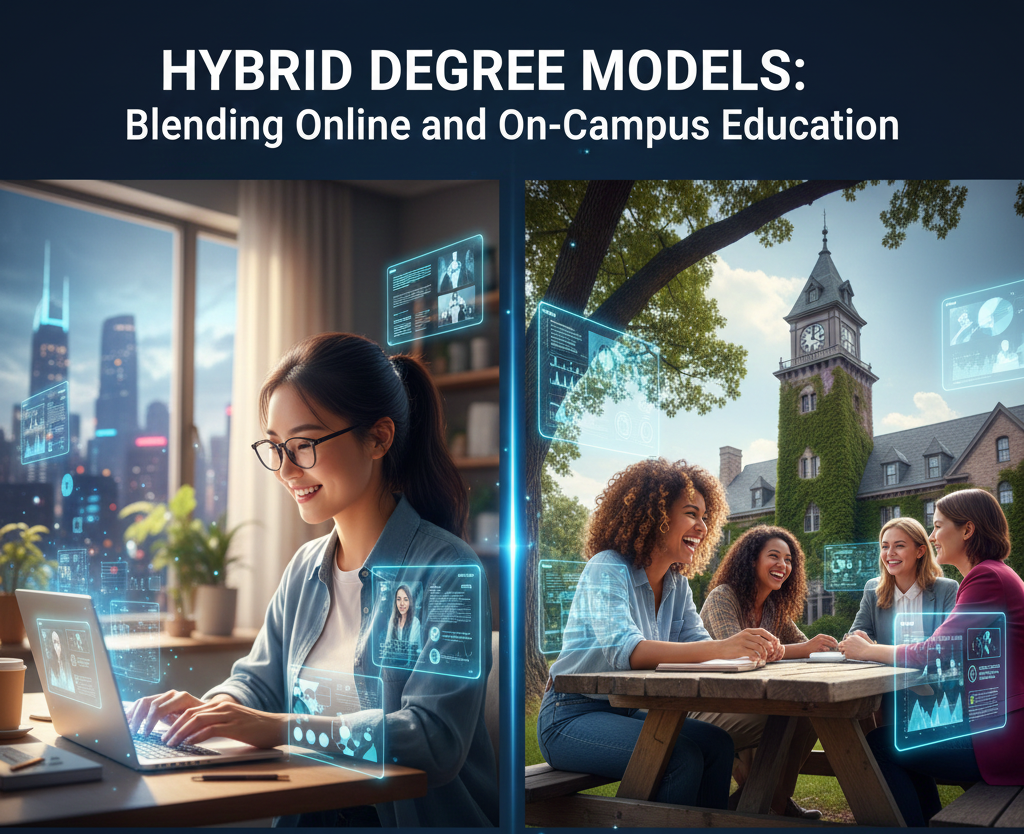
Hybrid Degree Models: Blending Online and On-Campus Education
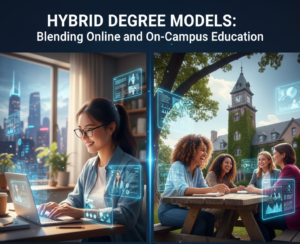
In the year 2025, higher education is undergoing a transformation as a result of hybrid degree models, which provide the flexibility of online learning in conjunction with the immersive involvement of on-campus experiences. This mixed method is becoming a fundamental strategy for institutions that are striving to make education more adaptive, inclusive, and in line with contemporary learning preferences. Hybrid degrees are becoming more prevalent as a strong model for the future of academic learning due to the evolution of technology and the changing expectations of students.
A New Definition of Flexibility for Institutions of Higher Learning
Students have the flexibility to decide when and how they will attend courses with hybrid degrees. While necessary practical work, laboratories, workshops, or seminars are undertaken on campus, lectures, tutorials, and exams may be accessible online. It is because of this flexibility that students who are working professionals, foreign students, and those who are balancing personal obligations are able to attend institutions of higher learning.
Assisting in the Development of Various Learning Approaches
Hybrid models take into account the fact that every student has a unique learning style and tackle this diversity by providing a variety of ways to interact in the learning process. Online courses are intended for self-directed learners who like to study at their own speed, and on-campus seminars are designed to assist individuals who gain more from direct, in-person engagement. The combination guarantees that pupils will be able to adjust their educational path in order to accommodate their own talents and interests.
Making Use of Technology to Increase Participation
Technology is a crucial component of hybrid models. Students are able to maintain their level of engagement in the classroom even when they are not physically present on campus by using interactive online platforms, real-time discussion boards, virtual laboratories, and multimedia material. Hybrid programs are able to provide a more dynamic and immersive learning experience by combining digital resources with conventional teaching techniques.
Improving Interactions That Take Place on Campus
In contrast to the ease of online material, the opportunity for more in-depth conversations, practical experience, and collaborative projects is made available via on-campus sessions. Soft skills, which include communication, collaboration, and leadership, are vital for both academic achievement and professional development, and these workshops contribute to the development of these talents.
Increasing Access and Promoting Inclusivity
Students who are unable to attend programs on a full-time basis at a physical campus due to limitations such as financial constraints, personal circumstances, or geographic distance are able to participate in hybrid degree programs, which increase access to higher education. Higher education becomes more accessible and equitable for a varied group of students when it is provided with less travel, flexible scheduling, and remote learning choices.
Finding a Middle Ground between Theory and Practice
It is common for hybrid programs to separate academic information into online courses and to reserve practical applications for sessions that take place on campus. This guarantees that students will be able to get a thorough grasp via learning that is based on theory as well as experience in the real world. It is possible to improve one’s critical thinking and problem-solving skills via the maintenance of equilibrium between the two forms.
Improving Research and Project-Based Learning Opportunities
By integrating physical resources such as libraries, study centers, and labs with virtual collaboration technologies, hybrid models make it possible to facilitate project-based learning and research. Students have the option of carrying out their study remotely, analyzing their findings online, and then gathering together on campus for experiments or group projects. The successfulness of the academic development in question may be attributed to the use of this simplified technique.
Making Worldwide Cooperation and Engagement Possible
Students are able to work with their classmates from a variety of various locations via the use of hybrid learning. Opportunities for learning from a variety of cultural and intellectual backgrounds are made possible via virtual group work, worldwide seminars, and digital networking. The learning environment is enhanced by the blend of local campus experiences and global internet communication.
Improving the Ability to Manage One’s Own Time and to Work Independently
Students who are enrolled in hybrid degree programs build powerful abilities in both organization and time management. Compared to planned on-campus sessions, which push students to be more responsible and timely, online learning demands students to have more self-discipline. The fact that pupils are able to cultivate independence in this dual structure prepares them for professional settings in which flexibility and responsibility are highly valued.
Adjusting Educational Programs in Order to Meet the Requirements of the Contemporary Labor Force
In order to better represent the hybrid character of today’s industries, universities are revising their curriculums. Hybrid degree programs are preparing students for occupations in which digital communication, cooperation, and on-site collaboration coexist as remote and in-person work settings collide. Graduates develop the skills necessary to successfully navigate both virtual and real environments.
Improving Services Provided to Students
Academic assistance is made available to students outside of campus borders via the use of hybrid programs. Students are guaranteed to get uninterrupted support via the provision of virtual tutoring, online advising, digital wellness initiatives, and remote library resources. When combined, both virtual and in-person assistance have a greater impact on improving academic achievement and emotional well-being.
Maintaining Both Quality and Consistency
Universities use uniform grading, organized modules, and integrated digital platforms in order to uphold academic standards. The process of quality assurance guarantees that the on-campus and online components of the degree program are of similar worth, which contributes to the facilitation of an uninterrupted educational experience across all media.
The incorporation of the most effective components of both online and on-campus learning into hybrid degree programs is a revolution in the field of higher education. This method meets the expectations of a new generation of learners by providing flexibility, inclusiveness, engagement, and relevance to the workforce, all of which will be of importance in the year 2025. As technology continues to advance, hybrid education will continue to be a fundamental component in the development of university programs that are responsive, accessible, and prepared for the future.