How AI-Assisted Learning Is Reshaping University Curriculums
How AI-Assisted Learning Is Reshaping University Curriculums
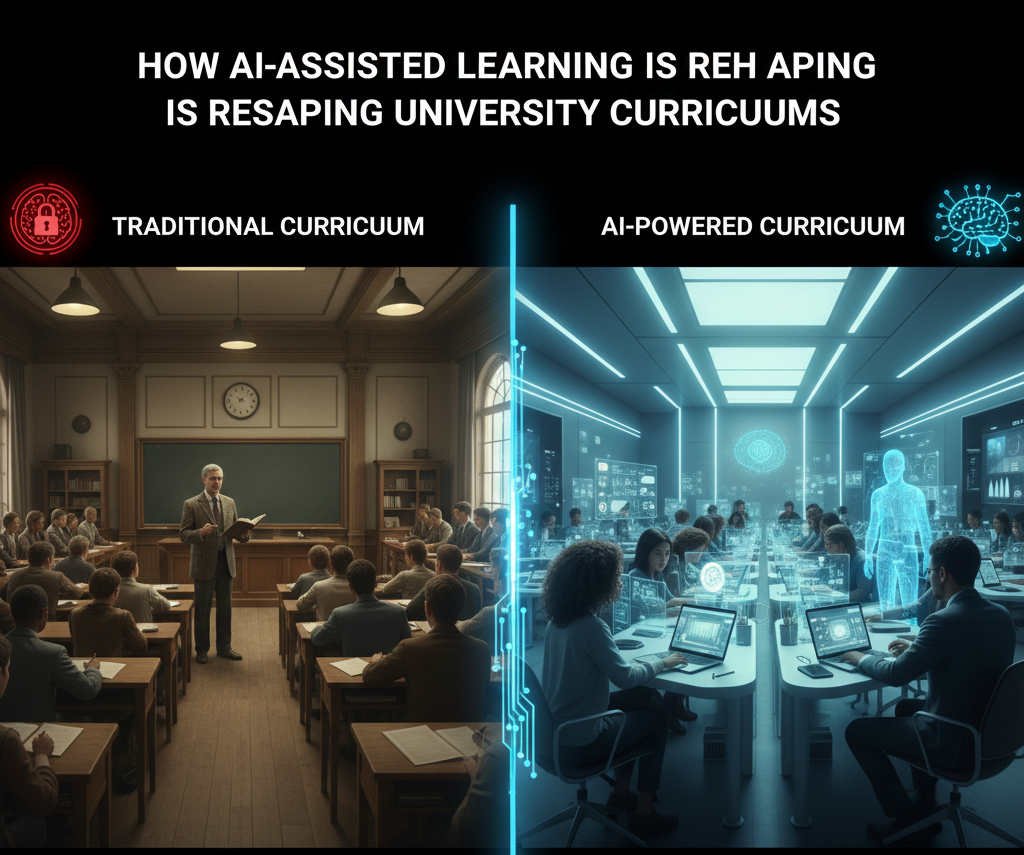
When compared to all of the technological transformations that have come before it, the impact that artificial intelligence is having on higher education is occurring at a far faster pace. In 2025, artificial intelligence (AI) has become an integral part of learning. It is no longer limited to basic automation or grading tools. AI is now profoundly impacting curriculum design, teaching methodologies, assessment methods, and student involvement. In order to guarantee that education stays relevant, adaptable, and in line with the requirements of the real world, educational institutions are in the process of completely revamping whole curricula using artificial intelligence capabilities.
Individualizing the Educational Journey
Universities may use platforms that are driven by artificial intelligence (AI) to construct curricula that are tailored to meet the specific requirements of each student. These systems alter the complexity of the material, the pace, and the resources that are suggested by analyzing patterns of learning, statistics on performance, and the techniques of study that are favored. The students are provided with customized assistance, which assists them in overcoming obstacles and advancing at a rate that is both comfortable and consistent. Success rates are being increased and the skill gaps that exist amongst learners are being narrowed as a result of this tailored method.
Curriculum Development Based on Data
Curriculum design is becoming more evidence-based and analytical. Educators are able to use artificial intelligence techniques to investigate patterns in student performance, pinpoint out-of-date course material, and determine which subjects require further concentration. Rather of depending on revision cycles that span many years, these insights assist colleges in making ongoing updates to their curricula. Through the use of data-driven redesign, it is possible to guarantee that academic material stays contemporary, relevant, and in accordance with industrial standards.
Increasing the Participation of Students by Utilizing Interactive Instruments
Artificial intelligence is driving interactive simulations, immersive learning modules, and customized exams, all of which help keep students interested in their studies. The use of these technologies allows for the conversion of passive lectures into active learning experiences. Students have the opportunity to engage with simulated settings, apply their practical skills via the use of simulations, or get instant feedback on their comprehension of challenging ideas. Deeper learning and improved retention are facilitated by forms that are engaging.
Assisting Faculty Members via the Use of Intelligent Teaching Assistants
Artificial intelligence (AI) teaching assistants are beneficial to faculty members in a number of ways. They aid with the administration of assignments, provide immediate solutions to frequently asked queries from students, and produce reports on learning analytics. This allows educators to concentrate their efforts on providing mentorship, giving individualized comments, and having conversations that are more sophisticated in nature. Educators are also aided by artificial intelligence systems, which may recommend new educational resources, compile summaries of the performance of students, and draw attention to areas where students may be having difficulties.
Academic Programs’ Incorporation of New and Innovative Technologies
The use of artificial intelligence (AI) in education motivates colleges and universities to include technological literacy into a wide variety of academic fields. In order to successfully complete programs in the fields of business, healthcare, engineering, social sciences, and even the arts, it is necessary for students to have a solid understanding of data interpretation, automation, and digital technologies. The incorporation of artificial intelligence into the classroom guarantees that students will acquire the necessary skills to succeed in modern companies that rely heavily on AI.
Enhancing the Mechanisms for Assessment and Feedback
There is a trend towards the supplementation of more traditional tests and set rubrics with evaluation approaches that are more dynamic in nature. By analyzing student contributions, artificial intelligence (AI) systems are able to pinpoint patterns of misunderstanding and provide tailored recommendations for how to improve. Students are able to use the feedback that is provided to them in real time by these platforms to improve their work well before the final assessments take place. An ongoing evaluation process that is supplemented by artificial intelligence gives a more accurate depiction of how much students are advancing and encourages continuous learning.
Supporting Worldwide, Cooperative Educational Experiences
Artificial intelligence (AI) is a technology that facilitates learning settings that are conducive to collaboration, enabling students from a variety of geographical locations to work together seamlessly. Intelligent platforms are responsible for managing job assignments, project monitoring, communication, and the establishment of groups. Artificial intelligence translation systems help to eliminate language barriers, which allows for multinational cooperation in ways that were previously difficult to handle. The preparation of students for multicultural work situations is accomplished via this global perspective.
Increasing the Availability of Accessible Education and Opportunities for All Students
Students who have impairments or who need specialized learning methods might greatly benefit from the use of artificial intelligence (AI)-assisted learning technologies. Classrooms that are more inclusive are made possible by the use of speech-to-text, text-to-speech, predictive typing, adaptive visual interfaces, and tailored resource suggestions. Students have the opportunity to interact with the material in a manner that is appropriate for their skill level, which leads to more involvement and a higher level of academic achievement overall.
Models of Lifelong Learning Support
In order to encourage lifelong learning, educational institutions are making use of flexible, competency-based curriculums that are driven by artificial intelligence. Students have the ability to review modules, access learning pathways that are unique to certain skills, and refresh their knowledge without being required to enroll in full-time programs. Artificial intelligence (AI) systems may assist individuals in monitoring their professional development objectives and provide educational alternatives that are in line with their career progression.
Promoting Moral Consciousness and the Ethical Application of Technological Innovations
As artificial intelligence becomes an increasingly important part of academic life, universities are including digital literacy, ethical considerations, and responsible technology usage into all of their curricula. Students are educated on the topics of data protection, algorithmic fairness, and the social ramifications of automation. Graduates will have a solid understanding of the ethical issues surrounding artificial intelligence (AI), as well as the ability to assess AI technologies in a responsible and critical manner, thanks to this focus on ethics.
Reforming the Processes Used for Administrative and Institutional Decision-Making
Universities may use artificial intelligence-based findings to modify their curriculums at the institutional level. Predictive analytics may be used to identify programs that are in high demand, skills that employers are emphasizing, and domains where student results might be improved. It is by using this information that administrators are able to reallocate resources, implement new courses, and cease to provide courses that are no longer relevant, which ultimately leads to the development of academic ecosystems that are more effective and responsive.
Getting Students Ready for a Future of Work That Is Dominated by Artificial Intelligence
Graduates who are looking to enter the modern workforce are expected to have a solid understanding of how to deal with artificial intelligence tools, how to comprehend insights that are generated by automation, and how to incorporate technology into their daily workflows. The use of artificial intelligence in the development of curricula guarantees that students are able to acquire proficiency in these skills via their firsthand experience with authentic situations and instruments. Graduates are able to join the workforce with a competitive edge and a more comprehensive awareness of the trends associated with digital transformation as a direct consequence of this.
The use of artificial intelligence to aid with learning is fundamentally changing the way that college curricula are designed. By 2025, universities will be providing students with the necessary tools to prepare them for a future in which artificial intelligence plays a crucial role in every occupation. They will do this via the implementation of personalized learning experiences, data-driven design, immersive learning, and adaptable academic routes. As schools continue to change, artificial intelligence will remain crucial to establishing academic environments that are creative, inclusive, and aligned with the quickly changing needs of the global workforce.