The Rise of Cross-Cultural and Multidisciplinary Higher Studies Programs
The Rise of Cross-Cultural and Multidisciplinary Higher Studies Programs
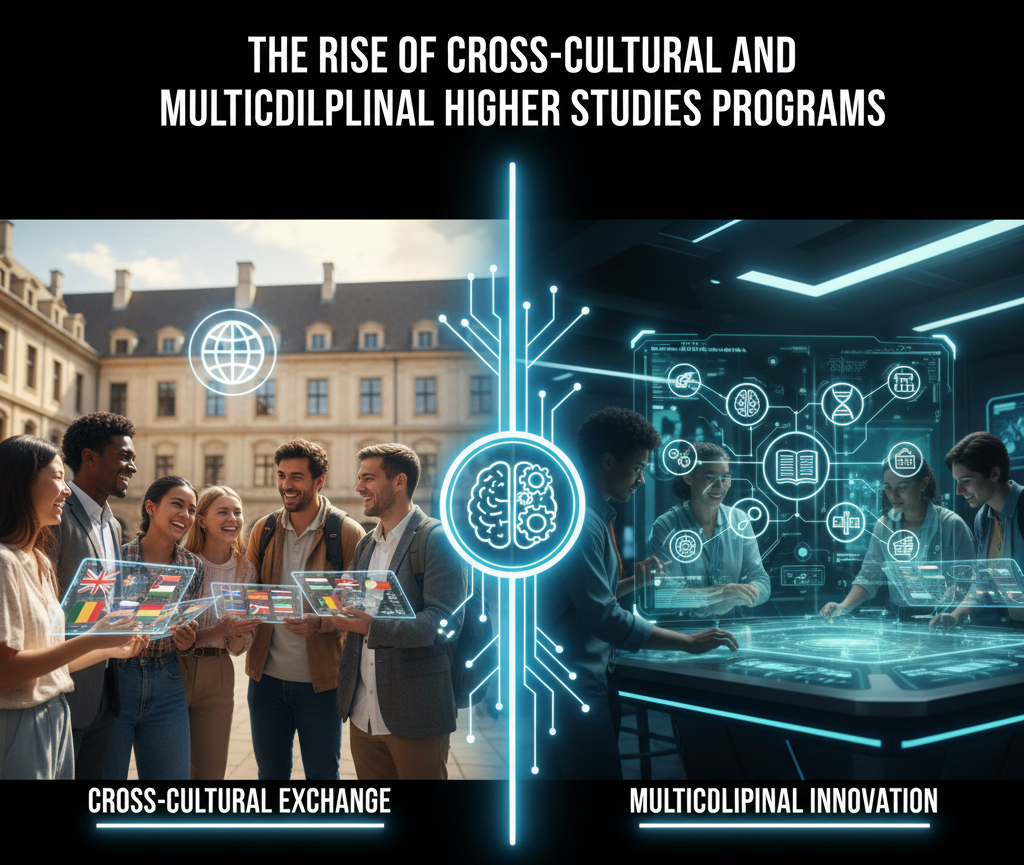
Due to the fact that information is becoming more and more globalized and that contemporary companies are becoming more and more linked, the educational sector of higher learning is placing more and more emphasis on interdisciplinary and cross-cultural programs by the year 2025. Students are provided with a wide range of viewpoints, collaboration abilities, and the capacity to address complicated issues on a global scale via the implementation of these programs.
Broadening One’s Viewpoint on a Global Scale
The purpose of cross-cultural programs is to provide students with the opportunity to be immersed in a variety of different academic and social settings. Graduates are prepared for professions on a worldwide scale since their exposure to a variety of educational systems and cultures helps to improve their capacity to communicate with people of other cultures, empathize with them, and adapt to their situations.
Combining a Variety of Different Fields of Study
Students are able to tackle issues from a variety of perspectives because to the combination of knowledge from a wide range of disciplines that is provided by multidisciplinary curricula. For instance, curricula might combine business with technology, environmental science with politics, or health sciences with social research, so encouraging creativity and comprehensive thinking.
Supporting the Concept of Collaborative Learning
Students enrolled in these programs often collaborate with a wide variety of people on research, case studies, and projects. Teamwork, leadership, and negotiating abilities are all abilities that are critical in cross-functional professional settings, and they are developed via the process of collaborative learning.
Expanding Possibilities for Research
Unique research opportunities are provided by programs that are both interdisciplinary and cross-cultural in nature. Students have the opportunity to examine comparative studies, global trends, and multidisciplinary solutions, which may lead to the generation of ideas that provide answers to difficult environmental, technical, and social problems.
Getting Pupils Ready for Professional Opportunities on a Global Scale
Graduates of these schools are prepared to work for global firms, international organizations, and research institutes. Because of their capability to traverse across a variety of cultural settings and their capacity to apply information across several fields, they are very important to the workforce.
Encouraging the Development of New Ideas and Solutions
Exposure to a wide variety of views and disciplines promotes creative thinking and the development of novel solutions. Students learn how to combine information from a variety of disciplines in order to tackle complicated issues, which encourages entrepreneurial activity, breakthrough research, and the formulation of new policies.
Making Use of Technological Advancements in Order to Collaborate
Students from a variety of various places are able to engage in workshops, conversations, and collaborative projects with one another thanks to the assistance of digital tools and online learning platforms, which encourage cooperation on a worldwide scale. The use of technology improves accessibility and adds to the quality of learning activities that take place across different cultures.
Encouraging Participation from All Members of the Community
By promoting tolerance, cross-cultural activities provide students the opportunity to be exposed to a wide range of viewpoints and to develop a greater appreciation for the various backgrounds of others. This results in the creation of a learning environment that places a high value on variety, seeing it as a positive asset in both educational and professional settings.
Increasing the Power of Collaborations with Institutions
Joint degree programs, exchange programs, and research projects are provided by universities in collaboration with schools from across the world. Students’ possibilities are expanded as a result of these relationships, which also establish networks that provide support for their professional and educational growth throughout the course of their lives.
By the year 2025, the emergence of higher education programs that are designed to be cross-cultural and interdisciplinary will lead to a transformation of the higher education system. Students are equipped to succeed in the multifaceted, quickly changing, and internationally linked world of today via the implementation of these programs, which make use of a wide range of viewpoints, multidisciplinary expertise, and experiences in teamwork.